Cyberlogic, inc Home
Software
Devices
Who We Are
R And D Activities
FEMdesigner
Bibliography
Contact Us


CyberLogic, inc.


Home | Device Home | Forearm Device | Heel Device | Contact Us


QRT® 250 Heel Scanner

The QRT® 250 Heel Scanner is an ultrasound based device designed to quantitatively assess the calcaneus (heel bone) at a location which is primarily trabecular (~90-96 percent). The calcaneus bone mass has been measured with x-rays for years and shown to be an excellent proxy for fracture risk. The QRT® 250 makes each radiation-free measurement in about a second, with a reproducibility of 1.1 percent. The QRT® 250 Heel Scanner—with its extremely low cost and excellent precision—should allow for much wider diagnosis and detection of individuals at risk of osteoporotic fracture.

The QRT® 250 is a through-transmission system that uses two circular single element transducers, operating at 1.5 MHz. The system is designed to measure the calcaneus at a position that depends on the length of the foot, and the transducers are translated to adapt to variations in foot (and calcaneus) size (U.S. Patent Pending).

The QRT® 250 incorporates CyberLogic's Net Time Delay (NTD) technology (U.S. Patent). The NTD parameter has been shown to be an excellent proxy for bone mass; see for example the papers located at our Website "A Portable Real-Time Ultrasonic Bone Densitometer" and "Ultrasound Simulation in Bone". These papers describe simulation data as well as clinical data obtained with two earlier versions of the QRT® 250.

Using CyberLogic's software package for ultrasound simulation (Wave3000™), we have shown how the NTD technology enables the bone mass, as represented by bone volume fraction, to be accurately estimated.

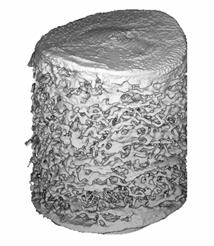
For example, the figure below shows a 3D micro-CT image of a core of a calcaneus.

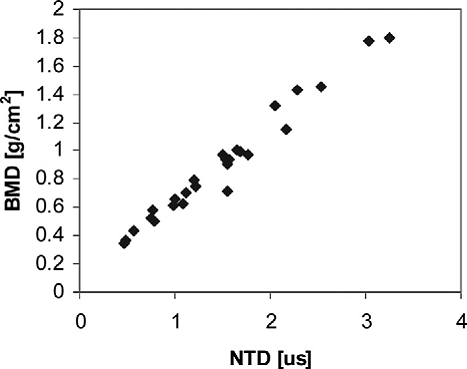
Thirty (30) such images served in a study of ultrasound propagation using 3D simulations (Wave3000, CyberLogic, Inc.). The simulated received waveforms were processed to obtain the NTD associated with each calcaneal image, and plotted versus the BMD. The BMD was computed directly from the 3D micro-CT image, using an assumed constant tissue density (of 1.85 g.cm-3). As may be seen, there is excellent correspondence between the NTD and BMD in this simulation study (this data has an R-squared value of 0.98).


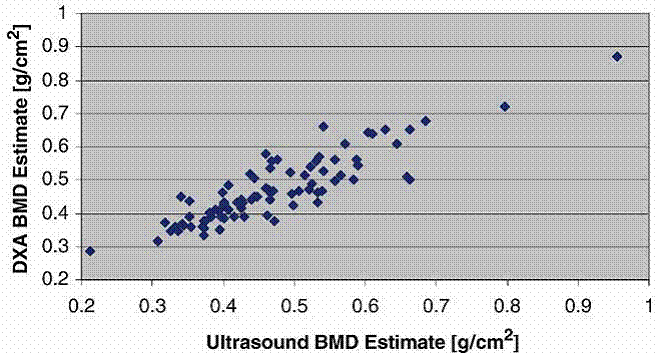
A clinical study was also carried out with an early handheld version of the QRT® 250. Briefly, eighty-eight (88) female adult subjects were ultrasonically interrogated and also measured with dual-energy x-ray absorptiometry (GE/Lunar PIXI bone densitometer) at the heel (below).


A linear multivariate regression (using age and NTD as independent variables) was used to determine an estimate of bone mass at the heel. The relationship between the ultrasound-based estimate of heel BMD and actual (DXA-determined) BMD is shown below, and demonstrates a linear correlation of 0.88 (P<0.001). This correlation is higher than presently FDA-approved ultrasound bone assessment devices, which have a correlation of about R=0.8.


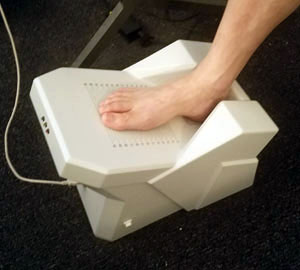
Although demonstrating high correlation with BMD, the handheld nature of the device led to relatively low precision, on the order of about 6 percent. In order to address this problem, the device was mechanically modified to be placed in a fixture which allowed it to function in a much more reproducible fashion. As may be seen in the two figures below, the foot is placed in a fixed position and the co-axial transducers are moved at a prescribed fixed angle an amount that is proportional to the ball length of the foot. The purpose of this is two-fold: (1) to ensure that approximately the same region of interest is ultrasonically assessed from one time to the next in the same subject; and (2) to ensure that approximately the same relative region of interest is measured in different subjects.

Both of these aspects are required in order to achieve accurate and precise estimation of bone strength and fracture risk. The first of these enables high reproducibility, while the second allows comparisons to be made among subjects; this is because the high degree of heterogeneity in calcaneal bone means that different relative regions of interest among individuals generally will have very different properties. For example, the figure shown below displays a contour plot of calcaneal BMD (in g/cm2) for a typical subject. The graph displays a rectangular region of about 3.3 x 3.8 cm, the posterior portion of the calcaneus at the bottom.


The approach as proposed here attempts to measure the lower density portion of the calcaneus near the posterior portion of the heel. The modified ultrasound device as shown above is based on a study of the region of interest as selected by the GE PIXI bone densitometer; it was designed to measure approximately the same region of interest by optimal selection of angle and translation length. The modified device was used in a follow-up clinical study on a new set of twenty-eight (28) subjects. The correlation of bone density as again measured by DXA (GE/Lunar PIXI done densitometer) and the NTD-determined estimate of bone mass with the foot-size specific modified ultrasound device was found to be 0.88 (this was achieved without using age as an independent predictor), and again higher than presently FDA approved ultrasound densitometers (see the figure below).


Of special note, the reproducibility of the modified device using multiple operators was found to be 1.1 percent, about the same as for x-ray absorptiometry. This implies that the new device design should enable it to be used for monitoring treatment as well as for detecting those individuals at increased risk of fracture.

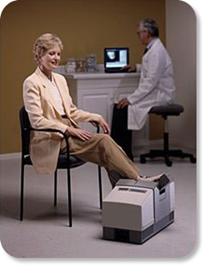
CyberLogic is presently incorporating NTD technology together with adaptive (to calcaneus size) identification of the region-of-interest in the QRT® 250 Heel Scanner (shown below).


The QRT® 250 Heel Scanner is expected, based on its high degree of accuracy and precision, together with its low cost, to significantly impact on the ability to identify those individuals at the greatest risk of fracture.

QRT® 250 Heel Scanner is an investigational device. Limited by US Federal law to investigational use.


(c)1997-2012 CyberLogic, inc. All Rights Reserved